
Trump Coin and Meme Tokens Blamed for Crypto Winter by Ross Gerber
Investor Ross Gerber says Trump coin and meme tokens caused the crypto winter by burning retail investors and draining confidence from the broader market.

When Bitcoin crossed $100,000 for the first time in late 2024, the crypto world celebrated. Investors cheered what seemed like the dawn of a new bull cycle, supercharged by the return of a self-proclaimed “crypto president” to the White House. Just over a year later, the picture looks dramatically different. Bitcoin has shed nearly 45% from its October 2025 peak, Coinbase reported a quarterly loss of $667 million, and the broader digital asset market is gripped by what many are calling a full-blown crypto winter. According to prominent fund manager and CEO of Gerber Kawasaki Wealth & Investment Management,
How Trump Coin and Meme Tokens Triggered the Crypto Winter
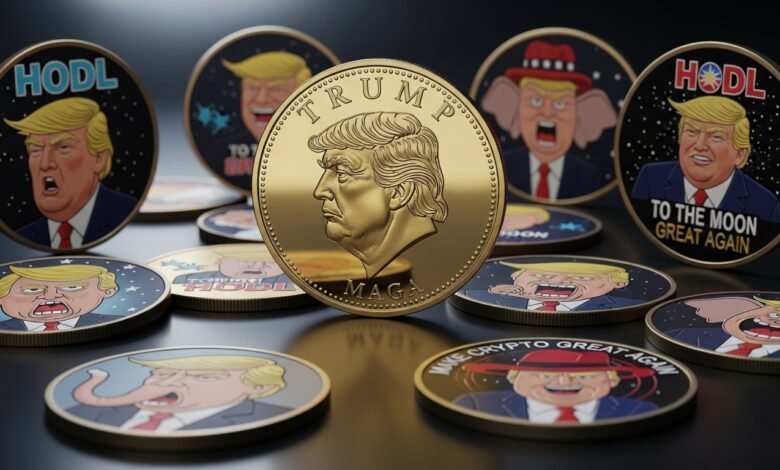
The story begins just three days before Donald Trump was sworn in for his second term. On January 17, 2025, the Official Trump (TRUMP) meme coin launched on the Solana blockchain with a circulating supply of 200 million tokens. Within hours, the coin surged more than 300%, briefly touching $75 before stabilizing in the mid-$20s range. Two days later, First Lady Melania Trump launched her own Official Melania (MELANIA) meme coin, and the dual token frenzy sent shockwaves — both in excitement and in congestion — across the Solana network.
For a fleeting moment, it felt like a breakthrough. Retail investors poured money in, convinced that the president’s personal involvement signaled legitimacy. But those who bought near the peak quickly learned a painful lesson. Since their respective launches, the TRUMP coin has collapsed by approximately 88%, while the MELANIA coin has dropped by a staggering 98% or more. The Trump family-affiliated World Liberty Financial (WLFI) token shed over 43% of its value in just one month. Hundreds of thousands of retail wallets were left holding nearly worthless assets while Trump-affiliated entities, which controlled 80% of the TRUMP token supply, reportedly generated over a billion dollars in pre-tax profits combined across all their crypto ventures.
Ross Gerber, speaking in a widely cited interview with Business Insider published in February 2026, argued that this sequence of events set off a chain reaction that goes far beyond the losses from the coins themselves. Celebrity-backed meme coins, he contends, are functioning as traps — and those traps are draining retail participation from the entire crypto ecosystem.
Ross Gerber on Why Meme Coins Destroy Crypto Trust
Gerber’s core argument is straightforward but damning. Meme coins launched or endorsed by celebrities — whether the TRUMP and MELANIA tokens, the coin tied to former New York City Mayor Eric Adams, or the $HAWK coin promoted by internet personality Haliey Welch — follow a nearly identical pattern. They launch with fanfare, attract retail investors riding the hype, and then crater almost immediately after insiders cash out. In each case, the people left holding the bag are everyday investors who believed in the narrative, not the project.
“People dive in and buy this stuff because they buy into the fraud, basically, and then they get burned, and that money doesn’t come back,” Gerber stated bluntly. He emphasized that the financial damage is only part of the problem. The deeper wound is psychological. When retail investors lose money on speculative meme tokens, they do not simply move on to the next trade. They exit the crypto market entirely — and they do not return. That means every meme coin crash is not just a localized loss event; it is a subtraction from the pool of new participants that Bitcoin and the broader market depend on for growth.
The HAWK Coin and the Celebrity Meme Coin Playbook
The $HAWK token case is illustrative of the broader pattern Gerber describes. Launched by influencer Haliey Welch, the coin attracted massive attention on social media and surged quickly after its debut — only to collapse just as fast, leaving retail buyers with steep losses. Similarly, former New York City Mayor Eric Adams launched a cryptocurrency that followed an almost identical trajectory.
The TRUMP meme coin fits this framework with uncomfortable precision. A forensic analysis commissioned by The New York Times found that over 813,000 wallets lost a combined $2 billion trading the TRUMP coin, while the president’s affiliated company and partners earned approximately $100 million in trading fees alone. For every dollar taken in trading fees by the token’s creators, investors reportedly lost $20.
The Broader Market Impact of Celebrity Meme Coin Mania
The damage from meme token speculation extends well beyond the coins themselves. Dogecoin (DOGE) and Shiba Inu (SHIB), two of the most established meme coins, also fell sharply during the broader market decline, adding to the sense of systemic rot. Trading firm Wintermute noted that capital has rotated heavily into AI-focused equities, leaving crypto underperforming in both market rallies and sell-offs — a pattern characteristic of entrenched bear markets.
Bitcoin, as of early 2026, is trading around $67,000–$69,000, a level that represents a dramatic fall from its October 2025 peak near $124,000. This puts Bitcoin below where it was trading before Trump was elected in November 2024, undermining the narrative that a crypto-friendly administration would automatically be bullish for digital assets. An early February sell-off triggered over $2.7 billion in liquidations, Bitcoin’s sharpest single decline since 2022, according to Wintermute, compounding already fragile sentiment.
Mohamed El-Erian, Chief Economic Advisor at Allianz and one of the world’s most respected economists, has expressed a view that aligns with Gerber’s analysis: Bitcoin will struggle to mount a sustained recovery until institutional investors meaningfully increase their participation. And that participation, Gerber suggests, is harder to attract when the overall crypto environment looks like a speculative carnival rather than a legitimate financial market.
Trump’s Regulatory Stance: Help or Hindrance?
One of the more counterintuitive dimensions of Gerber’s critique involves crypto regulation. During the 2024 election cycle, Trump positioned himself as the most pro-crypto candidate in American history, promising to slash regulation and establish a national Bitcoin reserve. Many investors expected this to be a tailwind. Gerber argues the opposite is happening.
A loose regulatory environment, far from attracting serious investment, has allowed bad actors and low-quality projects to flood the market unchecked. Without meaningful investor protections, the meme coin boom became a free-for-all that ultimately burned the retail investors crypto needs most. The Trump administration’s approach, Gerber believes, has made the market feel less disciplined and less trustworthy to the everyday investors who might otherwise have been onboarding for the first time.
This perspective is gaining traction. Representative Sam Liccardo introduced the Modern Emoluments and Malfeasance Enforcement Act — the MEME Act — which would prohibit sitting presidents, senior White House officials, members of Congress, and their immediate family members from launching or endorsing financial assets like meme coins. A House Judiciary Committee investigation, led by Representative Jamie Raskin, concluded in late 2025 that Trump’s cryptocurrency policies had directly benefited him personally, with the president adding billions to his net worth through crypto schemes entangled with foreign governments and corporate allies.
Is the Crypto Winter Temporary or a Structural Shift?
Not everyone shares Gerber’s degree of pessimism about the long-term outlook. Bernstein economists maintained their forecast of Bitcoin reaching $150,000 by the end of 2026. Fundstrat’s Tom Lee, a long-standing crypto bull, argues that Bitcoin may prove to be a more effective store of value than gold over time.
The question is whether that damage is a temporary sentiment cycle or something more structurally meaningful. Gerber clearly believes it is the latter — that the meme coin era has created a trust deficit that will take time and discipline to repair.
What is clear is that the Trump coin phenomenon has sparked a genuine policy and ethical debate that goes beyond price charts. Should celebrity meme coin promoters face legal accountability for projects that look — and function — like rug pulls?
What Needs to Change for the Market to Recover
Gerber’s implicit prescription is fairly straightforward. The crypto market needs new, legitimate participants — and the only way to attract them is to rebuild trust. That means cracking down on predatory meme coin schemes, establishing clearer regulatory guardrails that protect retail investors without stifling innovation, and separating legitimate blockchain projects from speculative celebrity cash grabs. Bitcoin’s historical rally cycles have always been driven by expanding adoption. Contracting that pool of potential adopters through repeated rug pulls and meme coin losses is, in Gerber’s view, the most self-destructive thing the crypto industry can do.
Conclusion
The story of Trump coin and meme tokens causing the crypto winter is ultimately a story about trust — how quickly it can be manufactured, and how completely it can be destroyed. Ross Gerber’s analysis cuts through the noise of short-term price movements to identify a more fundamental problem: when people who are new to crypto lose money to celebrity meme coins, they leave and they don’t come back. That loss of human capital — of future participants, future buyers, future believers — is what makes the meme coin era so costly for the long-term health of the market.
Want to stay ahead of the next market shift? The best investment you can make right now is in your own understanding of how these markets actually work.
See more;Eric Trump’s Cryptocurrency Firm Plunges 40% in Crypto Winter Crisis
