
Bitcoin Cycles and Volatility: What’s Coming Next in 2027
How Bitcoin cycles and volatility shape market movements. Learn key triggers, historical patterns, and expert predictions for crypto's future.

Bitcoin cycles and volatility is no longer optional for anyone serious about cryptocurrency investment—it’s essential. As we move deeper into 2025, the question on every investor’s mind isn’t whether Bitcoin will experience another cycle, but rather when the next major movement will occur and what will trigger it. The landscape of digital assets has matured significantly, yet the fundamental patterns of Bitcoin cycles and volatility remain remarkably consistent, offering both opportunities and risks for those who know how to read the signals.
Bitcoin Market Cycles
The concept of market cycles isn’t unique to cryptocurrency, but Bitcoin cycles and volatility exhibit characteristics that set them apart from traditional financial markets. Every four years, Bitcoin undergoes a halving event that reduces the mining reward by fifty percent, creating a supply shock that has historically preceded massive bull runs. These cycles have become somewhat predictable, though the magnitude and duration of each phase continue to evolve as the market matures.
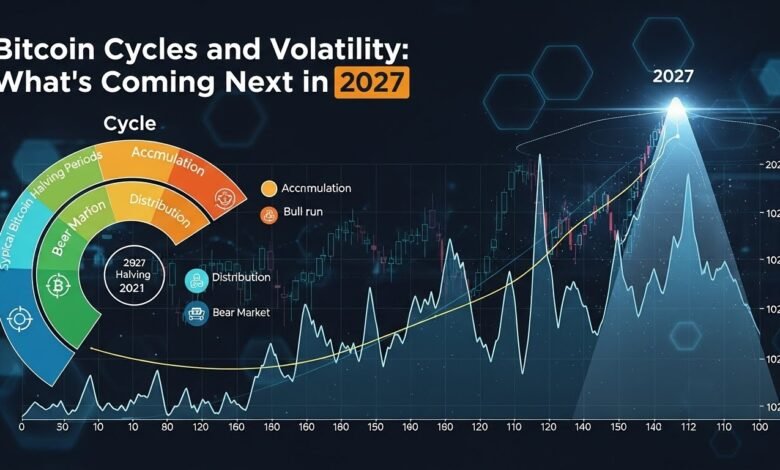
The anatomy of a typical Bitcoin cycle consists of four distinct phases: accumulation, markup, distribution, and markdown. During accumulation, smart money and long-term holders quietly build positions while prices remain relatively stable and public interest wanes. This phase often follows a significant market downturn and can last anywhere from several months to over a year. The accumulation phase represents the foundation upon which the next bull market will build, and recognizing this phase early can position investors for substantial gains.
The markup phase is what captures headlines and drives public interest. This is when Bitcoin cycles and volatility become most apparent to casual observers. Prices begin rising steadily, then accelerate as fear of missing out drives new participants into the market. Media coverage intensifies, institutional investors announce positions, and regulatory discussions dominate financial news. This phase has historically produced returns that exceed several hundred percent from cycle lows, creating both enormous wealth and cautionary tales of overleveraged positions.
Historical Patterns in Bitcoin Volatility
Examining past cycles reveals fascinating patterns in how Bitcoin cycles and volatility manifest across different market conditions. The 2013 cycle saw Bitcoin rally from around twelve dollars to over one thousand dollars before crashing back down. The volatility during this period was extreme, with daily price swings of twenty to thirty percent becoming almost routine. Despite the brutal correction that followed, this cycle established Bitcoin as something more than a fringe experiment.
The 2017 cycle brought mainstream attention unlike anything Bitcoin had experienced before. Starting the year around one thousand dollars, Bitcoin reached nearly twenty thousand dollars by December, only to enter a prolonged bear market that lasted through 2018 and into 2019. The Bitcoin cycles and volatility during this period taught investors harsh lessons about market timing, position sizing, and the dangers of overleveraging. Thousands of altcoins emerged during this cycle, many of which would never recover their all-time high values.
The most recent completed cycle, which peaked in late 2021, demonstrated how Bitcoin volatility patterns persist even as the market matures. Bitcoin reached approximately sixty-nine thousand dollars before entering another bear market that bottomed around fifteen thousand dollars in late 2022. What distinguished this cycle was the increased institutional participation, with companies adding Bitcoin to their treasury reserves and major financial institutions launching cryptocurrency services. This institutional involvement hasn’t eliminated volatility, but it has introduced new dynamics to how cycles unfold.
Key Volatility Triggers in the Bitcoin Market
Understanding what drives Bitcoin cycles and volatility requires examining the specific catalysts that move markets. Regulatory announcements remain among the most powerful volatility triggers, capable of moving prices ten to twenty percent within hours. When major economies signal openness to cryptocurrency adoption or, conversely, announce restrictive policies, the ripple effects extend throughout the entire digital asset ecosystem. The ongoing evolution of regulatory frameworks in the United States, European Union, and Asia continues to create uncertainty that manifests as price volatility.
Macroeconomic conditions have become increasingly important in driving Bitcoin cycles and volatility as the asset class has grown. Interest rate decisions by central banks, inflation data, and broader equity market movements now correlate more strongly with Bitcoin prices than ever before. During the 2022 bear market, Bitcoin moved largely in tandem with technology stocks, challenging the narrative of cryptocurrency as a hedge against traditional financial system instability. This correlation has important implications for how investors should think about portfolio diversification and risk management.
Technological developments and network upgrades also trigger significant volatility in Bitcoin cycles. The implementation of major protocol upgrades, developments in scaling solutions like the Lightning Network, and innovations in custody and security infrastructure all influence market sentiment. Additionally, the emergence of Bitcoin-related financial products, including exchange-traded funds and futures contracts, has created new mechanisms through which volatility can be amplified or dampened depending on market positioning.
The Role of Bitcoin Halving Events
No discussion of Bitcoin cycles and volatility would be complete without examining halving events, which occur approximately every four years when the block reward for miners is reduced by half. The most recent halving occurred in April 2024, reducing the block reward from six point two five to three point one two five Bitcoin. These events create predictable supply shocks that have historically preceded major bull markets, though the time lag between halving and peak prices has varied across cycles.
The mechanism behind how halvings influence Bitcoin cycles and volatility relates fundamentally to supply and demand dynamics. When the rate of new Bitcoin entering circulation decreases while demand remains constant or increases, basic economics suggests prices should rise. However, markets are forward-looking, and much of the halving impact may be priced in before the event occurs. The 2024 halving saw significant anticipation, with prices rallying in the months leading up to the event, followed by a period of consolidation that continues to play out.
Looking at post-halving patterns across previous cycles reveals that peak prices have typically occurred twelve to eighteen months after the halving event. The 2012 halving was followed by a peak in late 2013, the 2016 halving preceded the 2017 peak, and the 2020 halving came before the 2021 peak. If historical patterns hold, this suggests that the current cycle could potentially peak sometime in late 2025 or early 2026, though past performance never guarantees future results in markets as dynamic as cryptocurrency.
Institutional Adoption and Market Maturation
The landscape of Bitcoin cycles and volatility has transformed dramatically with the entry of institutional investors over recent years. Major corporations, hedge funds, and even nation-states have allocated portions of their portfolios to Bitcoin, fundamentally changing market dynamics. The approval of spot Bitcoin exchange-traded funds in the United States in early 2024 represented a watershed moment, providing traditional investors with regulated access to cryptocurrency exposure without the complexities of self-custody.
Institutional participation theoretically should reduce Bitcoin volatility over time as larger capital pools and more sophisticated risk management enter the market. However, institutions can also amplify volatility during periods of stress, as leveraged positions and risk management protocols force selling during downturns. The interaction between retail enthusiasm and institutional positioning creates complex dynamics that make predicting specific price movements challenging even for experienced analysts.
The infrastructure supporting Bitcoin has matured considerably, with robust custody solutions, insurance products, and professional-grade trading platforms now standard. This maturation influences Bitcoin cycles and volatility by reducing some technical risks while introducing new considerations around counterparty exposure and regulatory compliance. The collapse of several prominent cryptocurrency companies in 2022 demonstrated that infrastructure maturation doesn’t eliminate all risks, but it has created clearer distinctions between reputable institutions and reckless operators.
On-Chain Metrics and Market Intelligence
Sophisticated investors now use on-chain analysis to navigate Bitcoin cycles and volatility with greater precision than ever before. Metrics like the ratio of active addresses, exchange inflows and outflows, and the behavior of long-term holders provide insights into market positioning that weren’t available in earlier cycles. When large amounts of Bitcoin move from exchanges to cold storage, it typically signals that holders expect higher prices and are removing supply from immediate selling pressure.
The stock-to-flow model, which attempts to predict Bitcoin prices based on scarcity, gained popularity during previous cycles but has shown limitations in accurately forecasting the magnitude of Bitcoin volatility during both bull and bear markets. More nuanced approaches combine multiple on-chain metrics with macroeconomic indicators and sentiment analysis to develop probabilistic forecasts rather than point predictions. These methodologies acknowledge the inherent uncertainty in markets while still providing actionable frameworks for decision-making.
Realized capitalization, which values each Bitcoin at the price it last moved on-chain, offers insights into the aggregate cost basis of all holders. When the market price falls below the realized cap, it historically has indicated oversold conditions and attractive entry points. Conversely, when the market price extends significantly above the realized cap, it suggests frothy conditions where Bitcoin cycles and volatility may be approaching a local or cycle top. These metrics don’t provide perfect timing signals, but they offer valuable context for risk management decisions.
Global Economic Factors and Bitcoin
The relationship between Bitcoin cycles and volatility, and broader economic conditions has strengthened considerably as the asset class has grown. Bitcoin was created in the aftermath of the 2008 financial crisis with an explicit design philosophy emphasizing fixed supply and resistance to monetary manipulation. However, Bitcoin has increasingly traded as a risk asset, declining during periods of economic uncertainty and rising during risk-on environments, at least in the near to medium term.
Central bank monetary policy exerts a profound influence on Bitcoin volatility through its impact on liquidity conditions and investor risk appetite. The unprecedented monetary expansion following the COVID-19 pandemic contributed significantly to the 2020-2021 bull market, while the subsequent tightening cycle and interest rate increases corresponded with the 2022 bear market. As central banks navigate the complex challenge of controlling inflation without triggering recession, their policy decisions will continue shaping the environment in which Bitcoin cycles unfold.
Geopolitical tensions and currency crises in various regions have at times driven increased Bitcoin adoption as individuals seek alternatives to unstable national currencies. Countries experiencing hyperinflation or capital controls have seen surges in cryptocurrency usage, though this represents a small fraction of overall trading volume. Nevertheless, Bitcoin’s potential role as a neutral, censorship-resistant store of value could become increasingly relevant if global economic instability intensifies, potentially introducing new dynamics to traditional Bitcoin cycles and volatility patterns.
Technical Analysis and Price Patterns
Technical analysis provides another lens through which to examine Bitcoin cycles and volatility, with certain chart patterns and indicators showing remarkable consistency across multiple cycles. Moving averages, particularly the two-hundred-day moving average, have served as reliable indicators of trend direction, with sustained moves above or below this level often preceding significant directional movements. The relationship between short-term and long-term moving averages creates signals that, while not infallible, have historically helped investors identify major trend changes.
Fibonacci retracement levels and extension targets have shown surprising applicability to Bitcoin volatility patterns, with prices often finding support or resistance at mathematically derived levels. During bull markets, corrections of thirty to forty percent frequently find support around the zero point six one eight Fibonacci retracement level before resuming upward movement. These patterns don’t occur because markets respect mathematical ratios, but rather because enough market participants use these tools to create self-fulfilling prophecies around certain price levels.
Volume analysis provides crucial confirmation of price movements and helps distinguish between sustainable trends and temporary spikes driven by thin liquidity. High-volume breakouts from consolidation patterns tend to lead to more sustainable moves than low-volume drifts in price. During periods of compressed Bitcoin volatility, often represented by narrowing Bollinger Bands or contracting ranges, subsequent expansions typically lead to significant directional moves that define the next phase of the cycle.
What’s Coming Next: Current Cycle Outlook
As of late 2024 and moving into 2025, several factors suggest we may be in the middle stages of a post-halving bull market, though the path forward remains uncertain. The approval of Bitcoin exchange-traded funds has created a new source of sustained demand that didn’t exist in previous cycles, potentially extending the duration of Bitcoin cycles and volatility compared to historical patterns. Institutional allocation percentages remain relatively small, suggesting significant room for growth if confidence in the asset class continues to build.
However, several risks could disrupt the current cycle trajectory and introduce unexpected Bitcoin volatility. Regulatory crackdowns in major markets, technological vulnerabilities or exploits, macroeconomic deterioration, or loss of confidence in major cryptocurrency infrastructure providers could all trigger significant corrections. The interconnectedness of cryptocurrency markets means that problems in one sector can quickly spread throughout the ecosystem, as demonstrated by the contagion events of 2022.
Price predictions for Bitcoin range wildly among analysts, with some projecting conservative targets around one hundred thousand dollars and others forecasting prices exceeding five hundred thousand dollars within this cycle. Rather than focusing on specific price targets, sophisticated investors concentrate on risk management, position sizing, and maintaining discipline through the inevitable Bitcoin cycles and volatility that characterize cryptocurrency markets. Understanding that corrections of thirty to fifty percent can occur even within bull markets helps investors avoid panic selling during temporary pullbacks.
Risk Management in Volatile Markets
Successfully navigating Bitcoin cycles and volatility requires disciplined risk management that goes beyond simply hoping for higher prices. Position sizing represents the most fundamental risk management tool, with prudent investors limiting Bitcoin exposure to amounts they can afford to lose without compromising their financial security. The allure of life-changing returns can tempt investors to overallocate, but overleveraging has destroyed countless portfolios during inevitable market downturns.
Dollar-cost averaging, the practice of investing fixed amounts at regular intervals regardless of price, helps investors avoid the impossible task of timing market bottoms perfectly. This approach reduces the impact of Bitcoin volatility on entry prices by spreading purchases across different market conditions. While dollar-cost averaging may mean missing absolute bottom prices, it also prevents the paralysis that often keeps investors sidelined during optimal accumulation periods.
Stop-loss orders and profit-taking strategies help investors lock in gains and limit downside exposure, though implementing these tools requires careful consideration of Bitcoin’s notorious volatility. Stop-losses set too tightly can result in being shaken out during normal volatility before major moves, while stops set too loosely may fail to protect capital during genuine trend reversals. Finding the right balance requires understanding your own risk tolerance and investment timeline while respecting the reality of Bitcoin cycles and volatility.
The Future of Bitcoin Market Dynamics
Looking beyond the current cycle, the long-term evolution of Bitcoin cycles and volatility will likely be shaped by factors still emerging today. Increased institutional adoption could gradually reduce volatility as larger, more stable capital pools participate in the market. However, Bitcoin’s relatively small market capitalization compared to traditional assets means significant volatility will likely persist for years or even decades.
The development of Bitcoin-related financial instruments, including options, futures, and structured products, creates additional complexity in how Bitcoin volatility manifests. These derivatives allow for sophisticated hedging and speculation strategies that can either stabilize or destabilize prices depending on market positioning. The interplay between spot markets and derivatives has become increasingly important in understanding short-term price movements.
Technological developments, including improvements to Bitcoin’s base layer and second-layer scaling solutions, could influence adoption trajectories and therefore impact Bitcoin cycles and volatility. If Bitcoin successfully evolves to handle significantly higher transaction volumes while maintaining security and decentralization, its utility as both a store of value and medium of exchange could drive sustained demand growth. Conversely, failure to scale effectively could limit Bitcoin’s addressable market and constrain future cycle peaks.
Conclusion
Understanding Bitcoin cycles and volatility provides investors with frameworks for navigating one of the most dynamic and potentially rewarding asset classes in financial history. The patterns revealed through historical analysis, on-chain metrics, and macroeconomic context don’t offer certainty, but they do provide probabilistic guidance that beats pure speculation. As the current cycle continues unfolding, maintaining perspective on where we stand within the broader pattern can help investors make more informed decisions about positioning and risk management.
The question isn’t whether Bitcoin volatility will continue—it certainly will—but rather how investors can structure their approach to benefit from cycles while protecting themselves from the inevitable corrections. Those who combine historical pattern recognition with disciplined risk management and realistic expectations position themselves to potentially benefit from Bitcoin’s continued evolution as an asset class.
Whether you’re a seasoned cryptocurrency investor or someone considering initial exposure to Bitcoin, now is the time to deepen your understanding of market cycles and volatility patterns. Start by examining your current portfolio allocation, ensuring you’re positioned appropriately for your risk tolerance and investment timeline. Consider implementing dollar-cost averaging if you’re building a position, and review your risk management protocols to ensure they account for Bitcoin’s unique volatility characteristics. The next phase of Bitcoin cycles and volatility is already underway—will you be prepared to navigate it successfully?
See more;Tech Stocks Bitcoin Price: What Recent Performance Reveals
