
Bitcoin Tight Range Explosive Move: What’s Coming Next?
Bitcoin's tight range explosive move signals major volatility ahead. Discover what technical indicators reveal about BTC's next price breakout direction.

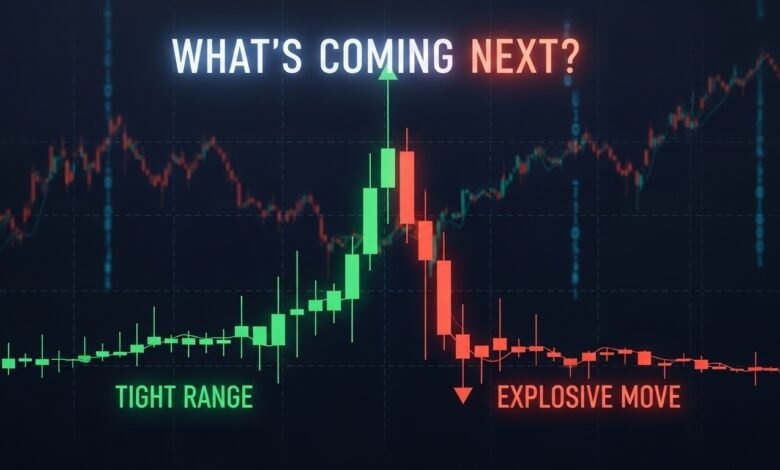
This Bitcoin tight range explosive move scenario is not unfamiliar to seasoned traders who understand that periods of extreme calm often precede significant volatility. As the world’s leading digital asset continues to oscillate within a narrow price corridor, the question on everyone’s mind is simple yet critical: which direction will Bitcoin break when this silence ends?
Understanding the dynamics behind Bitcoin’s current consolidation requires examining historical precedents, technical indicators, and the broader macroeconomic landscape that influences cryptocurrency markets. The Bitcoin tight range explosive move pattern we’re witnessing isn’t merely a random occurrence but rather a calculated pause before what many analysts believe could be a substantial directional shift. Whether you’re a long-term holder, active trader, or curious observer, comprehending what this compression means for Bitcoin’s future trajectory is essential for making informed decisions in an increasingly complex digital asset ecosystem.
Bitcoin’s Range-Bound Behavior
When Bitcoin enters a tight range, it signals that buying and selling pressures have reached a temporary equilibrium. This consolidation phase represents a battleground where bulls and bears engage in a silent standoff, neither side possessing sufficient momentum to push prices definitively higher or lower. The current situation exemplifies classic Bitcoin price consolidation, where trading volumes often decline, volatility contracts, and the market appears to hold its collective breath.
Historical data reveals that Bitcoin has experienced similar compression periods throughout its existence, and each instance has ultimately resolved with significant price movement. The BTC volatility compression we’re observing mirrors patterns seen before major bull runs and substantial corrections alike. What makes these periods particularly fascinating for technical analysts is their predictive potential when combined with the right indicators and market context.
The mechanics behind range-bound trading involve multiple factors converging simultaneously. Large institutional holders may pause accumulation or distribution activities, retail investors might adopt a wait-and-see approach, and algorithmic trading systems often dominate order flow during these quiet periods. This creates a feedback loop where reduced activity begets further consolidation, tightening the range until external catalysts or internal pressure forces a resolution.
Technical Indicators Signaling Imminent Volatility
Professional traders rely heavily on technical analysis tools to decode what Bitcoin tight range explosive move patterns might reveal about future direction. The Bollinger Bands indicator, which measures volatility by plotting standard deviations around a moving average, has contracted to levels rarely seen in Bitcoin’s history. When these bands squeeze tightly together, it historically precedes substantial price expansion in one direction or another.
The Average True Range (ATR), another crucial volatility measurement, has similarly declined to multi-month lows. This cryptocurrency range trading environment creates what technical analysts call a “volatility spring” that must eventually release its stored energy. The longer Bitcoin remains compressed within its current boundaries, the more explosive the eventual breakout tends to be, based on historical precedent.
Volume analysis provides additional context for understanding this consolidation phase. Trading volumes have diminished significantly compared to periods of active trending, suggesting that most market participants are positioned and waiting rather than actively accumulating or distributing. This behavior pattern typically indicates that a decisive move is approaching, though the direction remains uncertain until the breakout confirms itself through price action and volume confirmation.
The Relative Strength Index (RSI) has oscillated within neutral territory, neither signaling overbought nor oversold conditions. This neutral positioning on momentum indicators reinforces the balanced nature of current market conditions, where neither bulls nor bears have established dominance. However, once this equilibrium breaks, momentum indicators often provide early confirmation of the emerging trend direction.
Historical Precedents for Bitcoin Range Breakouts
Examining Bitcoin’s historical breakout patterns offers valuable insights into how the current situation might resolve. In 2020, Bitcoin spent several months consolidating between approximately seven thousand and ten thousand dollars before erupting into its historic bull run toward all-time highs above sixty thousand dollars. That consolidation phase exhibited similar characteristics to today’s market structure, including declining volumes, compressed volatility measurements, and widespread uncertainty about directional bias.
Conversely, not all range-bound periods resolve bullishly. In 2018, following Bitcoin’s dramatic decline from its previous all-time high, several consolidation phases occurred that ultimately broke downward rather than upward. These instances remind us that Bitcoin tight range explosive move scenarios can produce substantial losses as easily as impressive gains, depending on prevailing market conditions and fundamental factors.
The 2016 halving cycle provides another relevant case study. Bitcoin traded within a relatively tight range for months following the halving event before eventually breaking higher and initiating a multi-year bull market. This pattern has led many analysts to examine current price action through the lens of Bitcoin’s four-year halving cycle, though relying solely on historical patterns without considering current market conditions can be dangerously simplistic.
Statistical analysis of previous consolidation periods reveals that the magnitude of the eventual move often correlates with the duration and tightness of the preceding range. Ranges that persist for longer periods and exhibit tighter price boundaries tend to produce more explosive breakouts when they finally resolve. Current measurements suggest that if historical relationships hold, the impending move could be substantial regardless of direction.
Fundamental Factors Influencing Bitcoin’s Next Move
Beyond technical analysis, understanding the fundamental landscape surrounding digital asset price movement is crucial for anticipating Bitcoin’s trajectory. Macroeconomic conditions play an increasingly significant role in cryptocurrency valuations as institutional adoption has grown. Central bank policies, inflation dynamics, and traditional market performance all exert influence on Bitcoin’s price behavior in ways that were less pronounced during earlier market cycles.
Regulatory developments continue shaping investor sentiment and capital flows into cryptocurrency markets. Recent clarity from major jurisdictions regarding digital asset frameworks has reduced some uncertainty, potentially creating conditions favorable for institutional capital deployment. However, regulatory environments remain fragmented globally, and new policy announcements can trigger rapid sentiment shifts that break Bitcoin out of consolidation patterns.
The maturation of Bitcoin infrastructure, including spot exchange-traded funds, custody solutions, and institutional trading platforms, has transformed market dynamics compared to previous cycles. These developments have increased market efficiency and liquidity while potentially reducing the extreme volatility that characterized earlier periods. However, they haven’t eliminated Bitcoin’s capacity for significant price swings, particularly when breaking out of compressed ranges.
On-chain metrics provide additional fundamental insights into market conditions. Metrics tracking long-term holder behavior, exchange inflows and outflows, and accumulation patterns reveal that a substantial portion of Bitcoin supply remains in strong hands showing no signs of capitulation. This supply dynamic suggests that when the current Bitcoin price consolidation resolves, available liquid supply might be insufficient to meet demand if the breakout occurs to the upside.
The Role of Market Psychology During Consolidation
Market psychology during cryptocurrency range trading periods evolves through distinct phases that influence participant behavior. Initially, traders who profited from the preceding trend or suffered losses become uncertain about the new market structure. This uncertainty creates hesitation, reducing trading activity and contributing to range formation. As consolidation persists, frustration often builds among participants expecting clearer directional movement.
Fear and greed, the primary emotional drivers in financial markets, reach a temporary equilibrium during tight ranges. Neither emotion dominates sufficiently to drive prices beyond established boundaries. This psychological standoff creates the conditions necessary for explosive moves because once either fear or greed gains the upper hand, participants who have been sitting on the sidelines often rush to enter positions, amplifying the initial breakout movement.
Contrarian investors sometimes view extended consolidation as an opportunity, recognizing that markets cannot remain range-bound indefinitely. These participants may gradually accumulate positions during quiet periods, anticipating that the eventual breakout will provide significant returns. Their accumulation activity, while subtle during the range, can provide underlying support that influences breakout direction.
Social media sentiment and search trend analysis reveal shifting public interest in Bitcoin during consolidation phases. Typically, mainstream attention wanes when prices stabilize, reducing new participant inflows. However, this reduced attention can create ideal conditions for accumulation by sophisticated investors before the next wave of public interest arrives following a decisive breakout.
Trading Strategies for Range-Bound Markets
Navigating a Bitcoin tight range explosive move scenario requires distinct strategies compared to trending markets. Range-bound trading approaches focus on buying near support levels and selling near resistance boundaries while maintaining strict risk management protocols. However, traders must remain vigilant for breakout signals that would invalidate range-trading strategies and require position adjustments.
Conservative traders often reduce position sizes or exit the market entirely during extended consolidation, preferring to wait for clearer directional signals before committing capital. This approach sacrifices potential profits from range trading but protects capital from false breakouts and whipsaw movements that frequently occur during consolidation phases. For long-term investors, these periods often represent accumulation opportunities if fundamental conviction remains strong.
Breakout traders prepare during consolidation by identifying key levels that would confirm directional moves if breached with conviction. These traders typically wait for price to move beyond range boundaries accompanied by increased volume before entering positions. While this approach means missing the initial breakout movement, it reduces exposure to false breakouts that quickly reverse back into the established range.
Options strategies become particularly interesting during BTC volatility compression periods. Straddle and strangle positions, which profit from large moves in either direction regardless of which way prices break, can be attractive when implied volatility is low relative to expected realized volatility. However, these strategies require precise timing and understanding of options pricing dynamics to execute profitably.
Institutional Impact on Bitcoin Volatility Patterns
The increasing presence of institutional investors has fundamentally altered Bitcoin technical analysis and volatility patterns compared to earlier market cycles. Large institutional participants often employ sophisticated trading strategies and maintain longer time horizons than retail traders, contributing to periods of reduced volatility as they accumulate positions gradually without creating obvious market impact.
Institutional order flow typically routes through over-the-counter desks and dark pools rather than public exchanges, making it less visible in traditional volume analysis. This hidden liquidity can create situations where apparent consolidation masks significant accumulation or distribution activity occurring outside public view. When these large positions eventually influence spot markets, the resulting moves can appear sudden despite having been telegraphed through less visible channels.
The launch of Bitcoin spot exchange-traded funds represents a watershed moment for institutional access to cryptocurrency exposure. These products have created new demand dynamics while simultaneously introducing additional complexity to market structure. ETF flows, tracking error management, and creation-redemption mechanisms all contribute to price formation in ways that differ from traditional cryptocurrency market dynamics.
Institutional risk management frameworks often involve systematic position adjustments based on volatility measurements and correlation factors. During cryptocurrency range trading environments, these systematic strategies may reduce position sizes or hedge exposures, potentially contributing to the continuation of low-volatility conditions. Conversely, when volatility emerges, these same frameworks may trigger rapid position adjustments that amplify initial breakout movements.
Global Economic Context and Bitcoin Correlation
Understanding digital asset price movement in the current environment requires examining Bitcoin’s evolving relationship with traditional financial markets. Correlation analysis reveals that Bitcoin’s price action has demonstrated varying degrees of connection to equity markets, particularly technology stocks, at different points in recent years. During risk-off periods, Bitcoin has sometimes traded as a risk asset alongside stocks, while at other times it has exhibited more independent behavior.
Inflation dynamics and currency debasement concerns continue driving a portion of Bitcoin demand from investors seeking protection against traditional monetary system risks. The narrative positioning Bitcoin as “digital gold” or a store of value independent of government monetary policy resonates particularly strongly during periods of aggressive central bank intervention or currency instability. Current macroeconomic conditions, with persistent inflation concerns despite central bank policy adjustments, provide a backdrop that could influence how the Bitcoin tight range explosive move scenario resolves.
Geopolitical tensions and their impact on traditional financial systems create additional context for cryptocurrency market behavior. When conventional payment systems face disruption or sanctions limit cross-border transactions, Bitcoin’s censorship-resistant properties become more valuable. These fundamental drivers can influence investor positioning during consolidation phases and potentially catalyze breakout movements when tensions escalate or resolve.
Interest rate environments directly affect opportunity costs for holding non-yielding assets like Bitcoin. Higher interest rates on traditional savings vehicles make Bitcoin less attractive from a pure yield perspective, while lower rates reduce the opportunity cost of holding digital assets. The current interest rate trajectory and central bank policy expectations factor into investor decision-making processes that ultimately influence whether range-bound conditions continue or resolve.
The Importance of Risk Management During Uncertainty
Regardless of which direction the Bitcoin tight range explosive move ultimately breaks, disciplined risk management remains paramount for preserving capital and positioning for long-term success. Setting predetermined stop-loss levels before entering positions protects against catastrophic losses if breakouts prove false or move against established positions. These protective measures become especially critical during volatile breakout periods when price movements can be swift and unforgiving.
Position sizing appropriate to individual risk tolerance and portfolio construction prevents any single trade from inflicting irreparable damage. Even confident directional bets should be sized to allow survival if the anticipated move fails to materialize or reverses unexpectedly. Professional traders often risk only small percentages of total capital on individual positions, recognizing that preservation of trading capital enables continued participation during future opportunities.
Diversification across different assets and strategies reduces portfolio sensitivity to Bitcoin-specific movements while maintaining exposure to cryptocurrency market growth. Balanced portfolios that include various digital assets, traditional investments, and cash reserves can weather unexpected market moves more effectively than concentrated positions. This diversification doesn’t eliminate risk but distributes it across multiple uncorrelated or partially correlated sources.
Emotional discipline separates successful long-term traders from those who struggle during challenging market conditions. The ability to follow predetermined trading plans without succumbing to fear during drawdowns or greed during rallies enables consistent execution of strategies designed to capture opportunities while managing downside risk. During Bitcoin price consolidation phases, maintaining this discipline prevents overtrading or abandoning sound strategies prematurely.
Preparing for Multiple Breakout Scenarios
Prudent investors and traders prepare for various potential outcomes rather than committing exclusively to bullish or bearish scenarios. Scenario planning involves identifying key price levels, fundamental catalysts, and market structure developments that would support different directional moves. This preparation enables rapid response when breakouts occur, reducing decision-making time during fast-moving markets.
Bullish breakout scenarios would likely involve price moving decisively above resistance levels established during the consolidation phase, accompanied by expanding volume and positive momentum indicators. In this scenario, targets would be calculated based on the range width projected from the breakout point, historical resistance levels, and Fibonacci extension measurements. Fundamental catalysts might include positive regulatory developments, institutional adoption announcements, or macroeconomic conditions favorable to alternative assets.
Bearish breakdown scenarios would see price breaking below established support with similar volume and momentum characteristics confirming the move. Downside targets would be calculated using similar technical projection methods while considering historical support zones and psychological price levels. Fundamental triggers might include adverse regulatory actions, macroeconomic strength in traditional markets reducing alternative asset appeal, or technical failures in Bitcoin infrastructure or security.
Neutral continuation scenarios, where the range persists longer than expected, also deserve consideration. Extended consolidation periods test trader patience and can create false breakout attempts in both directions before the legitimate directional move emerges. Preparing mentally and strategically for this possibility prevents premature position entry or abandonment of sound analytical frameworks.
The Broader Cryptocurrency Market Context
Bitcoin tight range explosive move dynamics don’t occur in isolation but within the broader cryptocurrency ecosystem that includes thousands of alternative digital assets. Bitcoin’s price action often influences the entire cryptocurrency market due to its dominant market capitalization and status as the primary trading pair for many altcoins. When Bitcoin breaks from consolidation, altcoin markets typically experience amplified volatility as capital flows between different segments of the digital asset space.
Market dominance metrics, which measure Bitcoin’s percentage of total cryptocurrency market capitalization, provide insights into capital allocation trends. Rising Bitcoin dominance during consolidation phases might suggest that investors are rotating from riskier altcoins into Bitcoin as a safer cryptocurrency holding, potentially presaging a significant Bitcoin move that attracts capital from across the ecosystem.
Decentralized finance (DeFi) protocols, non-fungible token (NFT) markets, and other cryptocurrency subsectors each maintain their own dynamics while remaining connected to Bitcoin’s broader price trends. Understanding these relationships helps contextualize Bitcoin’s current consolidation within the larger narrative of blockchain technology adoption and digital asset evolution.
Cross-exchange price discrepancies and arbitrage opportunities often diminish during tight trading ranges as market efficiency increases and price discovery converges across venues. Monitoring these metrics can provide early warning signs when market structure begins changing ahead of breakout movements, as divergences in prices or funding rates across platforms may indicate shifting positioning by sophisticated market participants.
Conclusion
The current Bitcoin tight range explosive move setup represents one of the most compelling market structures in recent cryptocurrency history. As volatility compression reaches extreme levels and market participants position for what could be a substantial directional shift, both opportunities and risks intensify for traders and investors alike. Understanding the technical indicators signaling imminent movement, historical precedents that inform probability assessments, and fundamental factors that could catalyze breakouts in either direction provides essential context for navigating this critical juncture.
Whether you’re actively trading in a cryptocurrency range trading environment or maintaining long-term positions, the principles of sound risk management, emotional discipline, and continuous learning remain paramount. The explosive move that emerges from this consolidation will create winners and losers based not just on directional calls but on how well participants have prepared their strategies, managed their risk exposure, and maintained the flexibility to adapt as market conditions evolve.
As this Bitcoin tight range explosive move scenario develops, staying informed through multiple analytical perspectives, maintaining realistic expectations about both potential profits and risks, and executing with discipline will separate those who capitalize on the opportunity from those who become casualties of volatility. The silence won’t last forever, and when Bitcoin speaks with its next major move, being prepared will make all the difference.
See more;Bitcoin Price Range-Bound: Liquidity Builds for Breakout
