
Bitcoin Holders Realized Losses Hit 30-Day High as Gold Soars
Bitcoin holders realized losses mark first 30-day negative streak since 2023 while gold reaches record highs. Discover what this means for crypto.

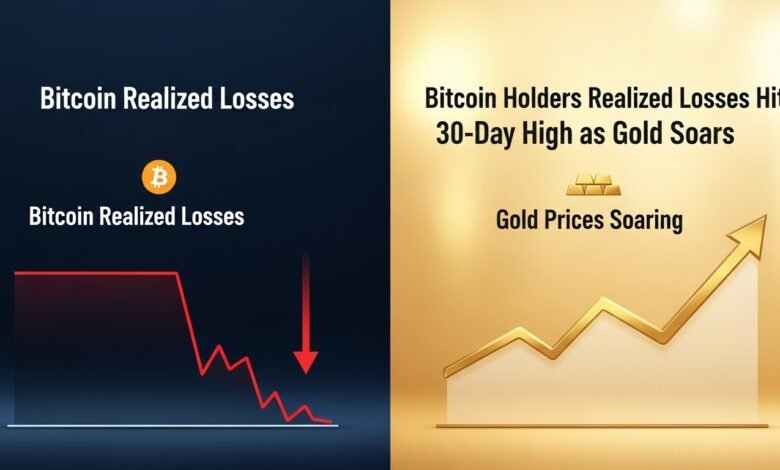
Bitcoin holders realized losses for the first time in a 30-day period since 2023, marking a concerning trend for digital asset investors. This development comes at a pivotal moment when gold has surged to a new all-time high, creating a stark contrast between traditional safe-haven assets and the digital currency space. Understanding the implications of these Bitcoin holders realized losses is crucial for investors navigating today’s volatile financial landscape. The divergence between Bitcoin’s performance and gold’s record-breaking rally signals a potential realignment of investor preferences and risk appetite in uncertain economic times.
Bitcoin Realized Losses: What the Data Reveals
When we examine Bitcoin holders realized losses, we’re looking at actual losses that investors have crystallized by selling their holdings below their purchase price. Unlike unrealized or paper losses, realized losses represent actual capital that has left investors’ portfolios, making this metric particularly significant for market analysis.
The recent 30-day period of negative realized profits marks the first such occurrence since 2023, suggesting a meaningful shift in market dynamics. During bull markets and stable periods, Bitcoin holders typically maintain positive realized gains as profitable positions are closed out. However, when Bitcoin holders realized losses dominate the landscape, it indicates widespread capitulation, forced selling, or strategic repositioning among investors.
The Mechanics Behind Realized Losses
Realized losses occur when investors sell their Bitcoin holdings at prices lower than their original purchase cost. This differs fundamentally from market value fluctuations, which only represent potential losses until an actual sale occurs. The current wave of Bitcoin holders realized losses suggests that many investors who purchased Bitcoin during previous price peaks are now exiting positions, either due to financial necessity, risk management strategies, or loss of confidence in near-term price recovery.
Blockchain analytics reveal that both long-term holders and short-term traders are contributing to these losses. Long-term holders, typically defined as those holding Bitcoin for more than 155 days, have historically been more resilient during downturns. Their participation in selling at a loss indicates deeper concerns about market conditions or personal financial pressures that override their conviction in Bitcoin’s long-term value proposition.
Why Are Bitcoin Holders Experiencing Realized Losses Now?
Several interconnected factors have contributed to the current environment where Bitcoin holders realized losses have become prevalent. The macroeconomic landscape plays a crucial role, with persistent inflation concerns, changing interest rate policies, and geopolitical tensions creating uncertainty across all asset classes.
Macroeconomic Pressures Driving Selling
Central bank policies worldwide have created a challenging environment for risk assets like Bitcoin. Higher interest rates make yield-bearing traditional investments more attractive relative to non-yielding assets like cryptocurrency. This dynamic has prompted some investors to reallocate capital from Bitcoin to bonds, money market funds, and dividend-paying stocks, resulting in Bitcoin holders realized losses as they exit positions established during more favorable rate environments.
The strength of the US dollar has also played a significant role. As the dollar appreciates against other major currencies, dollar-denominated assets like Bitcoin face headwinds. International investors holding Bitcoin may find themselves forced to sell and realize losses when converting back to their local currencies, even if Bitcoin’s dollar price remains relatively stable.
Regulatory Uncertainty and Market Sentiment
Regulatory developments continue to shape investor behavior in the cryptocurrency space. Recent enforcement actions, unclear regulatory frameworks in major markets, and ongoing debates about crypto classification have created an atmosphere of uncertainty. This regulatory ambiguity contributes to Bitcoin holders realized losses as some investors choose to reduce exposure rather than navigate potential future complications.
Market sentiment indicators have turned increasingly bearish, with fear and uncertainty dominating investor psychology. When negative sentiment persists, it often creates self-reinforcing selling pressure as investors rush to exit positions before further declines, amplifying Bitcoin holders realized losses in the process.
Gold’s All-Time High: A Flight to Traditional Safety
While Bitcoin struggles with realized losses, gold has achieved new all-time highs, demonstrating investors’ preference for time-tested safe-haven assets during uncertain times. This divergence between Bitcoin and gold performance highlights fundamental differences in how markets perceive these assets during stress periods.
Why Gold Is Outperforming Bitcoin
Gold’s recent rally to record levels reflects several powerful drivers. Central bank demand for gold has reached historic proportions, with institutions worldwide diversifying reserves away from traditional fiat currencies. Geopolitical tensions have accelerated this trend, as countries seek assets that cannot be frozen or sanctioned through the international financial system.
Unlike Bitcoin, gold has thousands of years of history as a store of value and medium of exchange. During periods of financial stress, investors instinctively gravitate toward assets with proven track records. While Bitcoin proponents argue it represents “digital gold,” the current market action suggests that in times of genuine uncertainty, physical gold’s tangible nature and established status provide comfort that digital alternatives cannot yet match.
The Traditional Safe-Haven Premium
Gold’s performance during the same period when Bitcoin holders realized losses accelerated demonstrates the enduring appeal of traditional safe havens. Institutional investors, family offices, and sovereign wealth funds often maintain significant gold allocations as portfolio insurance. When market volatility increases, these investors typically increase gold positions while reducing exposure to higher-risk assets, including cryptocurrencies.
The negative correlation between gold prices and real interest rates has strengthened, providing additional tailwinds for the precious metal. As inflation concerns persist and real yields remain subdued or negative, gold becomes more attractive relative to interest-bearing alternatives. This dynamic has created a powerful updraft for gold prices while simultaneously contributing to the environment producing Bitcoin holders realized losses.
Comparing Bitcoin and Gold Performance Metrics
The stark contrast between assets becomes even clearer when examining specific performance metrics over recent months. Gold has appreciated substantially while Bitcoin has experienced the volatility that has led to widespread Bitcoin holders realized losses among those who purchased during previous peaks.
Volatility Differences and Investment Implications
Bitcoin’s volatility remains significantly higher than gold’s, which partially explains the different investor experiences. While volatility creates opportunities for substantial gains, it also generates the conditions where Bitcoin holders realized losses become more likely. Investors who purchased Bitcoin near local peaks find themselves underwater quickly when corrections occur, whereas gold’s steadier appreciation provides more predictable returns.
The liquidity profile of these assets also differs meaningfully. Gold markets benefit from deep, established global trading networks and well-understood pricing mechanisms. Bitcoin, despite growing maturity, still experiences liquidity crunches during high-volatility periods, potentially forcing some holders to realize losses when they cannot exit positions at desired prices.
What 30-Day Realized Losses Signal for Bitcoin’s Future
The emergence of Bitcoin holders realized losses over a sustained 30-day period carries important implications for Bitcoin’s near-term and long-term trajectory. Historically, extended periods of realized losses often precede significant market bottoms, as weak hands are flushed out and conviction buyers accumulate at lower prices.
Historical Context and Pattern Recognition
Previous instances of prolonged Bitcoin holders realized losses have typically occurred during bear market capitulation phases. In 2022, similar patterns emerged before Bitcoin established a bottom and began its eventual recovery. The 2018-2019 bear market also featured extended periods where realized losses dominated before prices stabilized and began ascending.
However, each market cycle presents unique characteristics, and past patterns don’t guarantee future outcomes. The current macroeconomic environment differs substantially from previous Bitcoin bear markets, with higher interest rates, elevated inflation, and increased correlation between Bitcoin and traditional risk assets creating new dynamics.
On-Chain Metrics and Market Structure
Blockchain analytics reveal that coins changing hands at a loss are increasingly coming from addresses that held Bitcoin for moderate timeframes, suggesting that neither panic-selling newcomers nor steadfast long-term holders are the primary sources of Bitcoin holders realized losses. Instead, investors who purchased during the past year or two are reassessing positions and cutting losses.
This pattern indicates genuine uncertainty rather than irrational panic, which has different implications for market recovery. Rational reassessment based on changed circumstances may take longer to reverse than emotional panic selling, potentially extending the period of Bitcoin holders realized losses before sentiment shifts.
Investment Strategies During Periods of Realized Losses
For investors navigating markets characterized by Bitcoin holders realized losses, several strategic approaches merit consideration. Dollar-cost averaging remains a time-tested method for accumulating assets during volatile periods, allowing investors to build positions without trying to time exact bottoms.
Risk Management and Portfolio Positioning
During periods when Bitcoin holders realized losses are widespread, strict risk management becomes paramount. Investors should clearly define position sizes relative to overall portfolio value, ensuring that potential further losses remain within acceptable tolerance levels. Stop-loss orders, while controversial in cryptocurrency circles, can provide automated discipline for those concerned about additional downside.
Diversification across asset classes takes on heightened importance when specific assets are underperforming. The simultaneous strength in gold while Bitcoin holders realized losses mount suggests that balanced portfolios containing both traditional and digital assets may better weather current market conditions than concentrated cryptocurrency positions.
Identifying Potential Accumulation Opportunities
Contrarian investors often view widespread realized losses as potential buying opportunities, reasoning that markets tend to bottom when pessimism reaches extremes. The presence of sustained Bitcoin holders realized losses could indicate that we’re approaching such inflection points, though confirmation through price action and sentiment indicators remains essential.
Accumulation during these periods requires patience and emotional discipline, as trying to catch falling knives rarely succeeds. Instead, systematic accumulation strategies that incrementally build positions as technical and fundamental indicators improve tend to produce better risk-adjusted returns than aggressive bottom-fishing attempts.
The Broader Cryptocurrency Market Context
While Bitcoin dominates headlines regarding Bitcoin holders realized losses, the broader cryptocurrency market provides additional context for understanding current dynamics. Alternative cryptocurrencies have generally experienced even more severe drawdowns, with many showing larger percentages of holders underwater on their positions.
Altcoin Performance and Market Leadership
The relationship between Bitcoin and alternative cryptocurrencies during periods of Bitcoin holders realized losses often reveals important market structure information. When Bitcoin leads the market lower while altcoins decline even more severely, it typically indicates risk-off sentiment where investors flee to the relative safety of the most established cryptocurrency before potentially exiting the sector entirely.
Current market conditions show this exact pattern, with many altcoins declining 60-80% from previous highs while Bitcoin’s decline, though painful, has been comparatively moderate. This dispersion in returns suggests that capital is concentrating in Bitcoin when it remains in crypto at all, rather than rotating among different digital assets.
Institutional Versus Retail Behavior
The composition of those experiencing Bitcoin holders realized losses matters significantly for understanding market dynamics. Data suggests that retail investors have been the primary source of selling pressure, while some institutional players have maintained or even increased positions. This divergence indicates that sophisticated investors may view current prices as accumulation opportunities despite the prevalence of realized losses among the broader holder base.
Institutional involvement in cryptocurrency markets has grown substantially since previous bear markets, potentially creating different dynamics during recovery phases. If institutions continue accumulating while retail investors realize losses, the eventual market recovery could feature different characteristics than previous cycles, with potentially reduced volatility as the holder base becomes more sophisticated.
Technical Analysis: Support Levels and Resistance
Understanding where Bitcoin holders realized losses are most concentrated helps identify key technical levels likely to influence future price action. Clusters of investors who purchased at specific price points create natural support and resistance zones as those holders decide whether to cut losses or maintain positions.
Key Price Levels and Psychological Barriers
Several critical price levels have emerged where substantial numbers of Bitcoin holders face unrealized losses that may convert to Bitcoin holders realized losses if prices continue declining. The psychological round numbers also play important roles, as investors often make decisions based on these levels regardless of fundamental considerations.
Volume profile analysis reveals where the most Bitcoin changed hands during previous price advances, indicating price levels where many current holders established positions. If prices revisit these levels, the decision-making process of those holders—whether to cut losses or hold firm—will significantly influence whether support levels hold or break.
Long-Term Perspective: Bitcoin’s Value Proposition
Despite current challenges evidenced by Bitcoin holders realized losses, Bitcoin’s fundamental value proposition remains intact for those who view it through a multi-year lens. The fixed supply of 21 million Bitcoin, the decentralized nature of the network, and the growing global adoption continue to provide long-term support for the digital asset thesis.
Adoption Trends and Infrastructure Development
Even as Bitcoin holders realized losses dominate short-term metrics, long-term adoption trends continue developing positively. Lightning Network capacity has grown substantially, improving Bitcoin’s utility for everyday transactions. Corporate treasury adoption, while paused during current market conditions, has established precedents that may accelerate when macro conditions improve.
Regulatory clarity, when it eventually emerges, could provide the foundation for renewed institutional adoption. The current environment of uncertainty contributes to Bitcoin holders realized losses as some investors exit rather than navigate ambiguity, but resolution of these questions could reverse this dynamic and attract new capital to the ecosystem.
Conclusion
The first 30-day period of Bitcoin holders realized losses since 2023 marks a significant moment for cryptocurrency markets, occurring precisely when gold reaches new all-time highs. This divergence between traditional and digital safe havens reflects the complex macroeconomic environment where investors are reassessing risk tolerance and asset allocation strategies. While Bitcoin holders realized losses create near-term challenges and uncertainty, historical patterns suggest these periods often precede meaningful market bottoms and eventual recoveries.
For investors committed to cryptocurrency’s long-term potential, the current environment of Bitcoin holders realized losses may represent accumulation opportunities rather than reasons for panic. However, maintaining strict risk management, diversifying across asset classes, and approaching the market with realistic timeframes remains essential for navigating these challenging conditions successfully.
Whether Bitcoin can reclaim its narrative as digital gold or whether traditional gold continues dominating safe-haven flows will likely depend on evolving macroeconomic conditions, regulatory developments, and the cryptocurrency industry’s ability to demonstrate real-world utility beyond speculative trading. As the market digests these Bitcoin holders realized losses and participants reassess positions, the foundation for the next market phase is being established.
See more: New Bitcoin Buyers Lose Money for 2 Months Straight | 2026 Data
